Why everyday experiences can sometimes feel like too much.
Sometimes, it isn't one significant event that overwhelms us. It's the accumulation of smaller things.
An unanswered message. A growing list of responsibilities. An unexpected change of plans. A difficult conversation. A noisy environment.
Individually, these experiences might feel manageable. Together, they can leave us feeling irritable, exhausted, disconnected, or unable to decide what to do next.
But what is actually happening when we become emotionally overwhelmed?
The Science of Emotional Regulation
Emotional regulation describes our ability to influence how we experience, respond to, and express emotions.
It doesn't mean suppressing our feelings or maintaining a constant state of calm. It involves recognizing emotions and responding to them in ways that support our needs and goals.
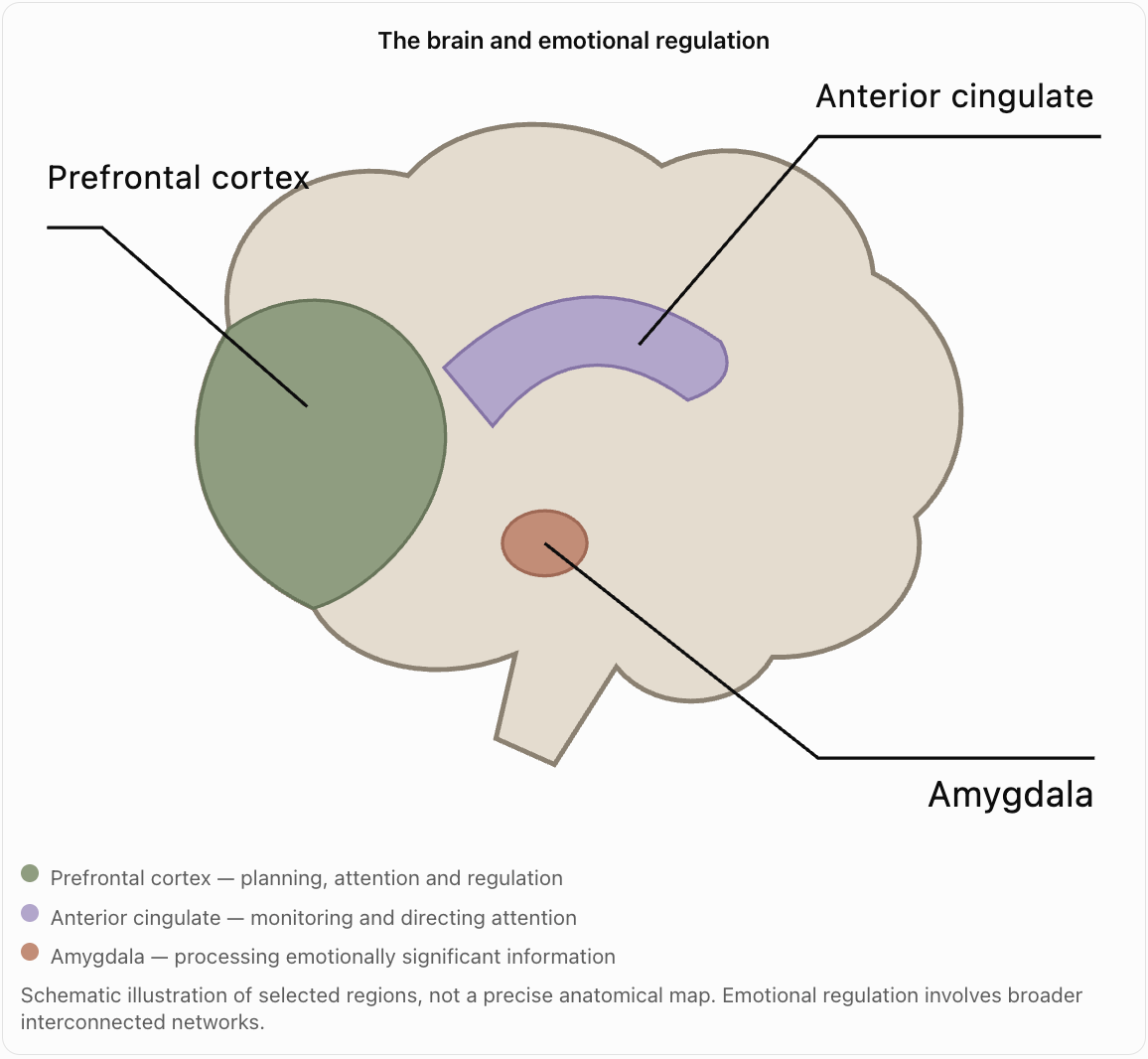
Several interconnected brain regions contribute to this process.
The amygdala helps identify emotionally significant information, including potential threats.
The prefrontal cortex supports decision-making, attention, impulse control, and the regulation of emotional responses.
The anterior cingulate cortex contributes to monitoring conflict, directing attention, and coordinating cognitive and emotional processes.
These regions communicate continuously. Emotional experiences are not controlled by a single part of the brain.
When the demands of a situation exceed our available coping resources, managing these processes can become more difficult.
What Stress Does to the Brain
When we encounter a stressful situation, the body activates biological systems that help us respond to potential challenges.
These include the sympathetic nervous system and the hypothalamic-pituitary-adrenal axis, which contribute to physiological changes involving adrenaline and cortisol.
These responses can be adaptive. They help prepare us to respond to demanding circumstances.
However, excessive or uncontrollable stress can interfere with the cognitive processes we rely on to think clearly.
In a review published in Nature Reviews Neuroscience, neuroscientist Amy Arnsten explained that even relatively mild, uncontrollable stress can impair prefrontal cognitive functioning.
This helps explain why, during overwhelming moments, we may struggle to:
Organize our thoughts.
Remember what we intended to say.
Consider another person's perspective.
Make decisions.
Shift our attention away from a stressful experience.
The mental resources we need to navigate a situation may become less accessible precisely when we need them most.
Emotional Overwhelm and ADHD
Emotional regulation difficulties are common among people with ADHD, although they are not required for an ADHD diagnosis.
A 2014 review published in the American Journal of Psychiatry by Shaw and colleagues concluded:
“Emotion dysregulation is prevalent in ADHD throughout the lifespan.”
The researchers identified differences in networks connecting regions involved in emotional processing, attention, and behavioral regulation.
For some individuals with ADHD, these difficulties may appear as intense frustration, rapid emotional shifts, difficulty disengaging from upsetting experiences, or challenges managing emotional responses.
This does not mean that every person with ADHD experiences emotions in the same way. Emotional overwhelm can also occur in people without ADHD and may be influenced by anxiety, sleep, chronic stress, environmental demands, and other factors.
What Emotional Overwhelm Can Look Like in Everyday Life
Emotional overwhelm isn't always obvious.
Sometimes, it looks like becoming irritated when someone asks a simple question after a demanding day.
Sometimes, it looks like avoiding messages because responding feels like another responsibility.
Sometimes, it looks like struggling to explain your feelings during a disagreement, only to understand what you wanted to say hours later.
And sometimes, it looks like shutting down during a major life transition because too many responsibilities, expectations, and unfamiliar experiences are competing for your attention.
These experiences are worth exploring with curiosity.
Creating Space Between Emotion and Action
Understanding your patterns can help you recognize what you need before responding automatically.
Consider experimenting with the following:
Notice your early signals. Are you becoming tense, distracted, impatient, or unusually sensitive to noise?
Reduce competing demands. Give yourself permission to address one responsibility at a time when possible.
Create space before responding. During a difficult conversation, communicate that you need time to gather your thoughts.
Name what you are experiencing. Identifying whether you feel frustrated, overstimulated, disappointed, or exhausted may help you better understand your needs.
The goal isn't to eliminate uncomfortable emotions. It is to develop greater awareness of how they influence your behavior.
A Moment of Reflection
When I feel overwhelmed, what is my first instinct? Do I withdraw, become reactive, overthink, or try to control everything around me?
Recognizing your patterns creates an opportunity to respond more intentionally.
Emotional well-being is not measured by how rarely you experience difficult emotions, but by how you learn to navigate them.
References
Shaw, P., Stringaris, A., Nigg, J., & Leibenluft, E. (2014). Emotion dysregulation in attention deficit hyperactivity disorder. American Journal of Psychiatry, 171(3), 276–293. https://pubmed.ncbi.nlm.nih.gov/24480998/
Arnsten, A. F. T. (2009). Stress signalling pathways that impair prefrontal cortex structure and function. Nature Reviews Neuroscience, 10, 410–422. https://pubmed.ncbi.nlm.nih.gov/19455173/
CHADD. Executive Function Issues and ADHD. https://chadd.org/adhd-news/adhd-news-adults/executive-function-issues-and-adhd/