Why having someone in your corner can help turn intentions into sustainable habits.
Think about the last time you made a promise to yourself.
Maybe you wanted to exercise more consistently, establish a morning routine, spend less time on your phone, or finally begin working toward a personal goal.
You were excited about the possibility of change. You understood why it mattered. Yet somewhere between making the commitment and following through, the initial motivation began to fade.
This experience reflects one of the most extensively studied challenges in behavioral science: the gap between intention and action.
Accountability can help bridge that gap. But its effectiveness goes beyond simply having someone remind you what you said you would do.
Why Intention Alone Is Not Enough
Setting a goal is an important part of behavioral change, but maintaining a behavior requires additional cognitive and environmental support.
Our brains must remember the goal, recognize opportunities to act, manage competing impulses, evaluate progress, and adjust our behavior when circumstances change.
These demands involve executive functioning and self-regulation.
When everyday responsibilities compete for our attention, even meaningful goals can become difficult to prioritize.
Accountability introduces external structure into this process. It creates opportunities to revisit our intentions, monitor our actions, and recognize the barriers influencing our behavior.
The Science of Monitoring Progress
One of the strongest research findings supporting accountability comes from a 2016 meta-analysis by Harkin and colleagues, published in Psychological Bulletin.
The researchers examined 138 experimental studies involving 19,951 participants to determine whether monitoring progress improved goal attainment.
They found that interventions encouraging people to monitor their progress were associated with greater success in reaching their goals.
Interestingly, the benefits were stronger when progress was recorded or reported to others.
The researchers concluded that:
“Monitoring goal progress is an effective self-regulation strategy.”
This finding helps explain why accountability can be valuable.
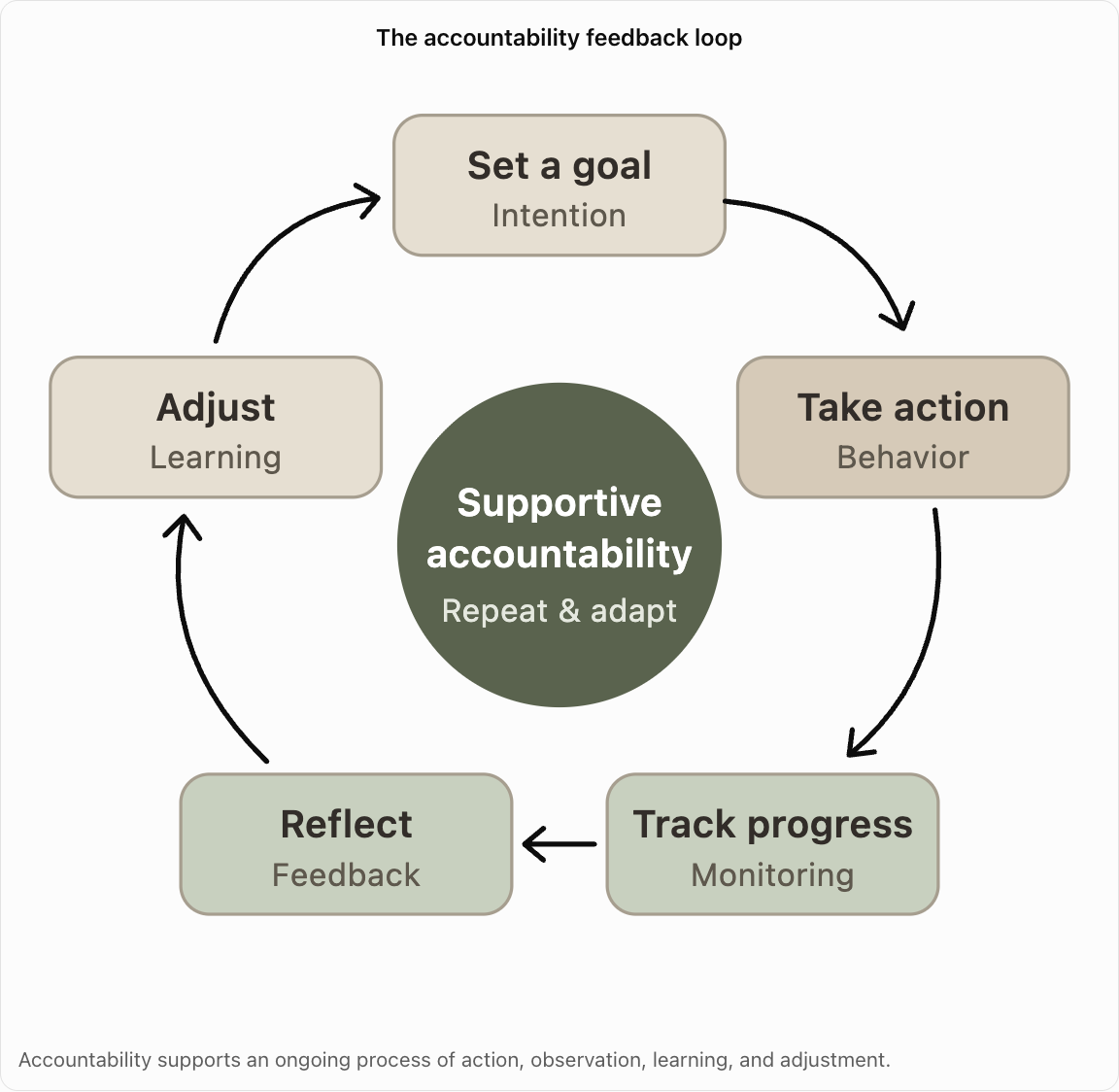
When we regularly review our actions, we create a feedback loop that allows us to compare our intentions with our actual behavior.
Rather than relying on a general feeling of whether we are making progress, we have information that can help us understand what is working and what needs to change.
What Happens in the Brain?
Behavioral change involves multiple interconnected brain systems. Three processes are particularly relevant to understanding how accountability may support habit development.
1. Executive Functioning and Goal Maintenance
The prefrontal cortex contributes to planning, decision-making, working memory, and goal-directed behavior.
Keeping a goal active in our minds while managing competing responsibilities requires cognitive effort.
External reminders, written commitments, and scheduled check-ins can reduce the need to rely exclusively on internal memory and self-monitoring.
An accountability partner may help bring an intention back into focus when everyday demands have pushed it into the background.
2. Learning From Feedback
The brain continuously learns from the consequences of our actions.
When we try a behavior and observe its outcome, we gain information that can influence future decisions.
Accountability creates opportunities to examine these outcomes intentionally.
For example, if you planned to exercise three times during the week but only exercised once, a supportive check-in can help you explore why.
Was the goal unrealistic? Was the timing inconvenient? Were there competing responsibilities? Did the activity feel meaningful to you?
Instead of interpreting the experience as a failure, you can use it as information to adjust your approach.
This process supports adaptive learning.
3. Habit Formation and Neuroplasticity
Neuroplasticity refers to the nervous system's ability to change in response to experience and learning.
Research on habit formation has identified the importance of brain circuits involving the basal ganglia, particularly the striatum, in the development of learned behavioral routines.
As we repeatedly perform an action in a consistent context, the association between the context and the behavior can become stronger.
Over time, the behavior may require less conscious deliberation to initiate.
Psychologists Wendy Wood and Dennis Rünger describe this process in their review, Psychology of Habit, explaining that habits develop through repeated responses in recurring situations.
Accountability can support the conditions that make repetition more likely. However, this does not mean that accountability itself has been proven to directly rewire specific brain circuits.
The neurological research explains how repeated learning can influence behavior; the behavioral research explains how monitoring and support can help us follow through more consistently.
Turning Goals Into Specific Actions
Another important concept in behavioral science is the implementation intention.
Developed through the work of psychologists Peter Gollwitzer and Paschal Sheeran, implementation intentions are specific plans connecting a situation with an intended action.
Instead of saying:
“I want to exercise more.”
You might decide:
“If it is Monday morning and I have finished breakfast, I will put on my walking shoes and walk for ten minutes.”
This approach establishes a clear cue and a specific response.
An accountability partner can help you explore whether your plan is realistic, review how it worked, and adjust it as needed.
Why Accountability Should Not Be Based on Shame
Effective accountability is not about being monitored, criticized, or pressured into performing.
When accountability becomes associated with fear or judgment, individuals may become more focused on avoiding disappointment than understanding their behavior.
Supportive accountability creates space for reflection, problem-solving, and ownership.
The National Board for Health & Wellness Coaching describes the coach's role as:
“One of accountability partner, not director.”
This distinction matters.
A coach does not decide what your goals should be or demand that you follow a particular path. Instead, coaching supports you in identifying meaningful goals, exploring barriers, developing action steps, and reviewing your progress.
The intention is to strengthen your ability to manage your own behavior, rather than create permanent dependence on another person.
How to Build Supportive Accountability
Consider starting with four simple practices:
Choose a meaningful goal. Identify why the behavior matters to you personally.
Make the action specific. Decide what you will do, when you will do it, and what will help you begin.
Create a feedback system. Record your progress or arrange a regular check-in with someone you trust.
Review and adjust. When something doesn't work, explore the circumstances and adapt your plan rather than abandoning the goal.
Behavioral change is rarely a perfectly linear process.
A 2024 systematic review of health-related habit formation found substantial variation in how long habits took to develop. There is no universal number of days required to establish a habit.
Consistency is built through repetition, adaptation, and time.
A Moment of Reflection
What is one commitment I keep making to myself, and what kind of accountability would make it easier to follow through?
Sometimes, the missing piece between intention and action is not another goal.
It is a system that helps you return to the goal you already have.
References
Harkin, B., Webb, T. L., Chang, B. P. I., et al. (2016). Does monitoring goal progress promote goal attainment? A meta-analysis of the experimental evidence. Psychological Bulletin, 142(2), 198–229. https://pubmed.ncbi.nlm.nih.gov/26479070/
Wood, W., & Rünger, D. (2016). Psychology of Habit. Annual Review of Psychology, 67, 289–314. https://pubmed.ncbi.nlm.nih.gov/26361052/
Graybiel, A. M. (2008). Habits, rituals, and the evaluative brain. Annual Review of Neuroscience, 31, 359–387. https://pubmed.ncbi.nlm.nih.gov/18558860/
Gollwitzer, P. M., & Sheeran, P. (2025). Psychology of Planning. Annual Review of Psychology, 76, 303–328. https://doi.org/10.1146/annurev-psych-021524-110536
Time to Form a Habit: A Systematic Review and Meta-Analysis of Health Behaviour Habit Formation and Its Determinants. (2024). Healthcare. https://pmc.ncbi.nlm.nih.gov/articles/PMC11641623/
National Board for Health & Wellness Coaching. Scope of Practice. https://nbhwc.org/scope-of-practice/